If you’re selling a rental property, a second home, or any property that isn’t your main residence, you need to understand Capital Gains Tax (CGT).
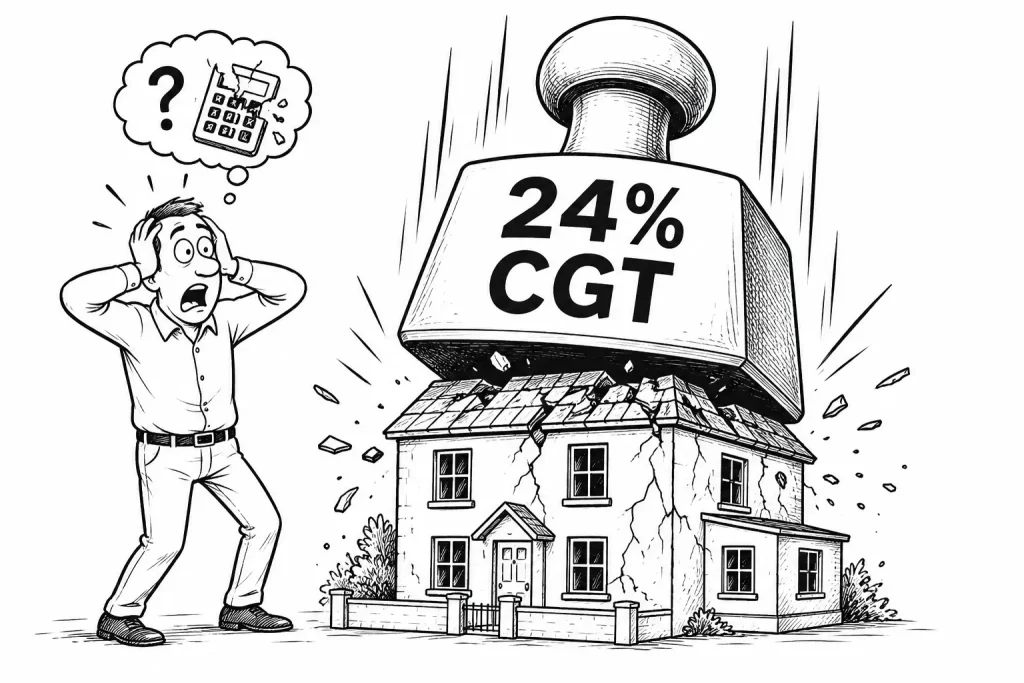
It can be a nasty shock. You sell a property for £100,000 more than you paid, think you’ve made a decent profit, then discover you owe HMRC £24,000 in tax.
Let me explain when you’ll pay CGT on property, how much it’ll be, and – most importantly – the legitimate ways to reduce it.
What Is Capital Gains Tax on Property?
Capital Gains Tax is a tax on the profit you make when you sell (or “dispose of”) an asset that’s increased in value.
For property, it works like this:
Sale price minus original purchase price minus allowable costs = gain
If that gain exceeds your annual CGT allowance (£3,000 for 2025/26), you pay tax on the excess.
Example:
You bought a rental property for £200,000 in 2015. You sell it in 2026 for £350,000.
Gain: £350,000 – £200,000 = £150,000
Less annual allowance: -£3,000
Taxable gain: £147,000
If you’re a higher-rate taxpayer, CGT at 24%: £35,280
That’s a significant chunk of your profit gone.
When Do You Pay CGT on Property?
You pay CGT when you sell or dispose of:
• Rental properties (buy-to-let)
• Second homes
• Holiday homes
• Commercial property
• Land
• Properties you’ve inherited and are now selling (unless it became your main home)
• Your share of a property you own jointly
You DON’T pay CGT on:
• Your main residence (the home you actually live in) – covered by Private Residence Relief
• Property you’re giving to your spouse or civil partner (though they’ll pay CGT when they eventually sell)
• Property left to someone in your will (the recipient may pay inheritance tax instead, and will pay CGT when they sell)
How Much Is CGT on Property?
For the 2025/26 tax year, CGT rates on property are:
18% if you’re a basic-rate taxpayer
24% if you’re a higher or additional-rate taxpayer
These rates increased from 18%/28% to 18%/24% in October 2024.
Important: It’s your overall income that determines which rate you pay, not just the property gain.
Example:
Your salary is £45,000 (within basic rate band of £50,270).
You make a £30,000 gain on a property sale.
The first £5,270 of gain is taxed at 18% (stays within basic rate band).
The remaining £24,730 is taxed at 24% (pushes you into higher rate).
Your income and gains stack together for tax purposes.
What Costs Can You Deduct?
You don’t just pay tax on the raw profit. You can deduct certain costs to reduce your taxable gain.
Purchase costs you can deduct:
• Original purchase price
• Stamp duty you paid when buying
• Legal fees for the purchase
• Survey costs
• Estate agent fees when you bought (if you paid them)
Sale costs you can deduct:
• Estate agent fees
• Legal fees for the sale
• Costs of advertising the property for sale
Improvement costs you can deduct:
• Extensions
• Conservatories
• Loft conversions
• New bathrooms or kitchens (as improvements, not repairs)
• Landscaping
• Installing central heating where there was none
Important: Only improvements count, not repairs or maintenance.
Replacing a broken boiler with a like-for-like one? That’s a repair – doesn’t reduce CGT.
Installing a new high-spec boiler where there was a basic one? That’s an improvement – does reduce CGT.
What you CAN’T deduct:
• Mortgage interest (even though you couldn’t deduct it for income tax either)
• Rental income costs (insurance, management fees, repairs) – those reduce income tax, not CGT
• Your own labor or time
• Furniture and furnishings (these don’t add to the property’s value for CGT purposes)
Your Annual CGT Allowance
Everyone gets an annual CGT allowance. For 2025/26, it’s £3,000.
You can make gains up to this amount without paying any CGT.
Important points:
• It’s per person, not per property
• You can’t carry it forward – use it or lose it each tax year
• It applies to ALL capital gains, not just property (shares, crypto, business assets, etc.)
If you and your spouse both own the property, you each get the £3,000 allowance – so £6,000 total between you.
Private Residence Relief – Your Main Home Is CGT-Free
If you sell your main residence – the home you actually live in – you don’t pay CGT.
This is called Private Residence Relief.
You get full relief if:
• It’s been your only home for the entire time you owned it
• You haven’t let any of it out
• The grounds are less than 5,000 square meters (just over an acre)
• You didn’t buy it just to make a gain
You get partial relief if:
• You lived in it as your main home for some of the ownership period
• You let part of it out while living there
• You used part of it exclusively for business
The relief is proportional. Live there for 5 years out of 10? You get 50% relief.
Lettings Relief – Mostly Gone
There used to be additional “Lettings Relief” of up to £40,000 if you let out your former main home.
From April 2020, this was mostly abolished. Now it only applies if:
• The property is your main residence
• AND you’re living in it at the same time as the tenant
• AND it’s not a separate dwelling
This basically means letting out a room in your home while you live there. That’s it.
If you moved out and let the whole property, Lettings Relief doesn’t apply anymore.
How to Reduce CGT on Property
Now the useful bit – legitimate ways to reduce what you pay.
Use your main residence
If possible, make the property your main residence before you sell.
You get the final 9 months of ownership covered by Private Residence Relief automatically, even if you’re not living there (as long as it was your main home at some point).
Example:
You bought a house 10 years ago, lived in it for 3 years, then let it out for 7 years.
When you sell:
• 3 years living there = Private Residence Relief
• Final 9 months = automatically covered
• Total: 3.75 years out of 10 = 37.5% of gain is tax-free
This only works if it was genuinely your main home at some point. You can’t fake this.
Split ownership with your spouse
If your spouse pays tax at a lower rate than you, or has unused CGT allowance, transfer part or all of your share to them before selling.
Transfers between spouses are CGT-free, so this doesn’t trigger a tax charge.
Then when they sell, the gain is taxed at their rate or uses their allowance.
Careful: You must genuinely transfer ownership. HMRC will challenge sham arrangements.
Time the sale
Your CGT allowance (£3,000) resets every 6 April.
If you’re selling at the end of a tax year, consider whether delaying completion by a few days into the new tax year means you can use two years’ allowances.
Example:
Gain of £50,000. Sale completing 31 March 2026.
Taxable gain: £50,000 – £3,000 = £47,000
If you delay to 7 April 2026:
You can use £3,000 from 2025/26 (if not already used) by making a payment on account before 5 April, then £3,000 from 2026/27.
This requires careful planning with your accountant.
Claim all legitimate costs
Did you do major improvements? Make sure you’re claiming them.
Extensions, loft conversions, new kitchen, landscaping – all reduce your gain.
Dig out old invoices. Even work done 20 years ago counts if you can prove it.
Offset losses
If you’ve made a loss on another asset (shares, another property, business asset), you can offset it against property gains in the same tax year or carry it forward.
Losses must be reported to HMRC, even if you’re not claiming them immediately.
Consider selling in stages
If you own multiple properties, don’t sell them all in one tax year.
Selling one per year means you use your £3,000 allowance each year.
Example:
Three properties, each with £20,000 gain.
Sell all three in one year: (£60,000 – £3,000) × 24% = £13,680 CGT
Sell one per year over three years: 3 × [(£20,000 – £3,000) × 24%] = £12,240 CGT
Saving: £1,440
Plus you’re not pushing all the gain into one year, which might push you into higher rate if you’re near the threshold.
Don’t forget about incorporation relief
If you transfer property into a limited company as part of incorporating a property business, you might be able to defer CGT.
This is complex and has strict conditions (must be a genuine business, not just passive letting).
Get specialist advice before attempting this.
Principal Private Residence Election
If you own two properties and live in both, you can elect which one is your “main residence” for CGT purposes.
You have 2 years from when you start owning both to make the election.
Strategic elections can save significant CGT if you’re planning to sell one.
When Do You Pay and Report CGT?
Reporting deadline:
You must report property sales to HMRC within 60 days of completion using the online CGT Property Disposal Return.
This is separate from your Self-Assessment tax return.
Payment deadline:
CGT is also due within 60 days of completion.
You can’t wait until the normal 31 January Self-Assessment deadline – it’s pay now or face penalties and interest.
How to report:
Through the HMRC online portal. You’ll need:
• Details of the property
• Purchase price and date
• Sale price and date
• All costs and improvements
• Calculation of the gain
If you’re not registered for Self-Assessment, you’ll need to create a Government Gateway account.
What If You Inherit Property?
If you inherit property, there’s no CGT when you inherit it (though there may be inheritance tax for the estate).
Your CGT calculation when you sell:
Your “purchase price” is the market value when you inherited it, not what the deceased originally paid.
Example:
Your parents bought a house for £150,000. They died in 2020 when it was worth £300,000. You sell it in 2026 for £350,000.
Your gain: £350,000 – £300,000 = £50,000
Not £350,000 – £150,000.
If you lived in it:
If you move into the inherited property and make it your main residence, you get Private Residence Relief from that point forward.
Live there for 2 years then sell? Those 2 years (plus final 9 months) are CGT-free.
CGT on Commercial Property
Slightly different rules for commercial property (offices, shops, warehouses, land):
• CGT rates are 18%/24% (same as residential since October 2024 – they used to be 10%/20%)
• You might qualify for Business Asset Disposal Relief (formerly Entrepreneurs’ Relief) if selling a business property – reduces rate to 14% for 2025/26 (rising to 18% from 2026/27)
• Different rules on what qualifies as improvements
Commercial property is beyond the scope of this article, but if you’re selling commercial property, get specialist advice.
Common Mistakes People Make
Assuming the property is CGT-free because they lived there once
Just because you lived in a property doesn’t mean it’s fully covered by relief. Only the period you lived there (plus final 9 months) is covered.
Not keeping records of improvements
You did a £30,000 extension 15 years ago but lost the invoices. You can’t claim it without proof.
Keep everything forever for any property you might sell.
Missing the 60-day deadline
Completion happens, you get the money, you forget about tax for a few months. Then you get a penalty for late filing and late payment.
Set a reminder when contracts exchange – CGT report and payment due within 60 days of completion.
Not claiming legitimate costs
Stamp duty, legal fees, estate agent fees – lots of people forget to deduct these. They can be several thousand pounds of saving.
Thinking you can offset rental losses
You can’t. Rental income losses reduce income tax, not CGT.
Only capital losses (on other assets) can offset capital gains.
Not using spouse’s allowance and lower rate
If one of you is a basic-rate taxpayer and the other is higher-rate, you’re potentially wasting the lower rate and double allowance by not transferring ownership.
The Bottom Line
CGT on property can be substantial – 18% or 24% of your gain above £3,000.
Make sure you:
• Deduct all legitimate costs (purchase, sale, improvements)
• Use your annual allowance (£3,000 for 2025/26)
• Consider transfers to spouse if beneficial
• Time sales strategically if you own multiple properties
• Keep records of everything forever
• Report and pay within 60 days of completion
The rules changed significantly in recent years – higher rates from October 2024, loss of most Lettings Relief from 2020, shorter reporting timelines.
If you’re selling a property with a substantial gain, get advice before you exchange contracts. Once the sale completes, your options for reducing CGT are very limited.
Frequently Asked Questions
How much is Capital Gains Tax on property in 2025/26?
18% if you’re a basic-rate taxpayer, 24% if you’re a higher or additional-rate taxpayer. These rates increased from 20%/28% in October 2024. Your income and gains are added together to determine which rate applies. You also get a £3,000 annual CGT allowance before any tax is due.
Do I pay CGT on my main home?
No. Your main residence (the home you actually live in) is covered by Private Residence Relief and is CGT-free when you sell. This applies to the entire period you lived there as your only home, plus the final 9 months of ownership automatically.
Can I avoid Capital Gains Tax on a second property?
You can reduce it, but not completely avoid it unless you make it your main residence. Legitimate ways to reduce CGT include: using your £3,000 annual allowance, claiming all purchase and sale costs, claiming improvement costs, transferring ownership to a spouse in a lower tax band, or timing sales across multiple tax years.
How do I report property Capital Gains Tax?
You must file a CGT Property Disposal Return online within 60 days of completion and pay the tax within the same timeframe. This is separate from your Self-Assessment tax return. Use the HMRC online portal – you’ll need a Government Gateway account if you don’t have one already.
What costs can I deduct when calculating CGT?
Purchase costs (original price, stamp duty, legal fees, survey), sale costs (estate agent fees, legal fees, advertising), and improvement costs (extensions, conversions, new kitchens/bathrooms as improvements). You cannot deduct repairs, maintenance, mortgage interest, or furniture costs.
Do I pay CGT if I inherit a property?
Not when you inherit it, but you will pay CGT when you sell it. Your “purchase price” for CGT purposes is the market value when you inherited it, not what the deceased originally paid. If you move in and make it your main home, you get Private Residence Relief from that point forward.
Can I transfer property to my spouse to avoid CGT?
Transfers between spouses are CGT-free, so you won’t trigger a charge when transferring. This is useful if your spouse is in a lower tax band or has unused CGT allowance. However, when they eventually sell, CGT will be calculated on the original gain – you’re deferring it, not avoiding it, but potentially at a lower rate.
What is the CGT allowance for 2025/26?
£3,000 per person. This means you can make up to £3,000 in capital gains in the tax year without paying any CGT. If you own property jointly with your spouse, you each get the £3,000 allowance (£6,000 total). The allowance applies to all capital gains, not just property.
Do I still get Lettings Relief?
Mostly no. Lettings Relief was largely abolished from April 2020. It now only applies if you live in the property at the same time as your tenant (like renting out a room while you live there). If you moved out and let the whole property, Lettings Relief doesn’t apply.
Can rental property losses reduce my CGT?
No. Rental income losses only reduce income tax, not CGT. Only capital losses (losses on selling assets like shares, other properties, or business assets) can be offset against capital gains. You must report capital losses to HMRC even if you’re not using them immediately.
Need help with Capital Gains Tax on property? Property tax is what we do. We can calculate your exact CGT liability, identify all legitimate deductions, explore ways to reduce what you pay, and handle the 60-day reporting requirements
“Disclaimer: Paul Stankiewicz is the owner and principal at Paul Marks & Co Chartered Accountants which is the trading name of Paul Marks Ltd a Limited Company registered in England and Wales (registered number 4487645).This article is designed for the information of readers only and is the opinion of the author only. Readers should not act on any of the information contained in this article without seeking professional advice. Nothing in this article constitutes advice, nor does the transmission, downloading or sending of any information or the Material create any contractual relationship. Links to third party websites are provided as a convenience to the reader, Paul Marks Ltd does not control and is not responsible for any of those websites or their content. Paul Stankiewicz and Paul Marks Ltd accepts no liability or responsibility whatsoever for any loss or damage suffered by any user of the information contained on or accessed through this article or the Material downloaded.